
Arutanga
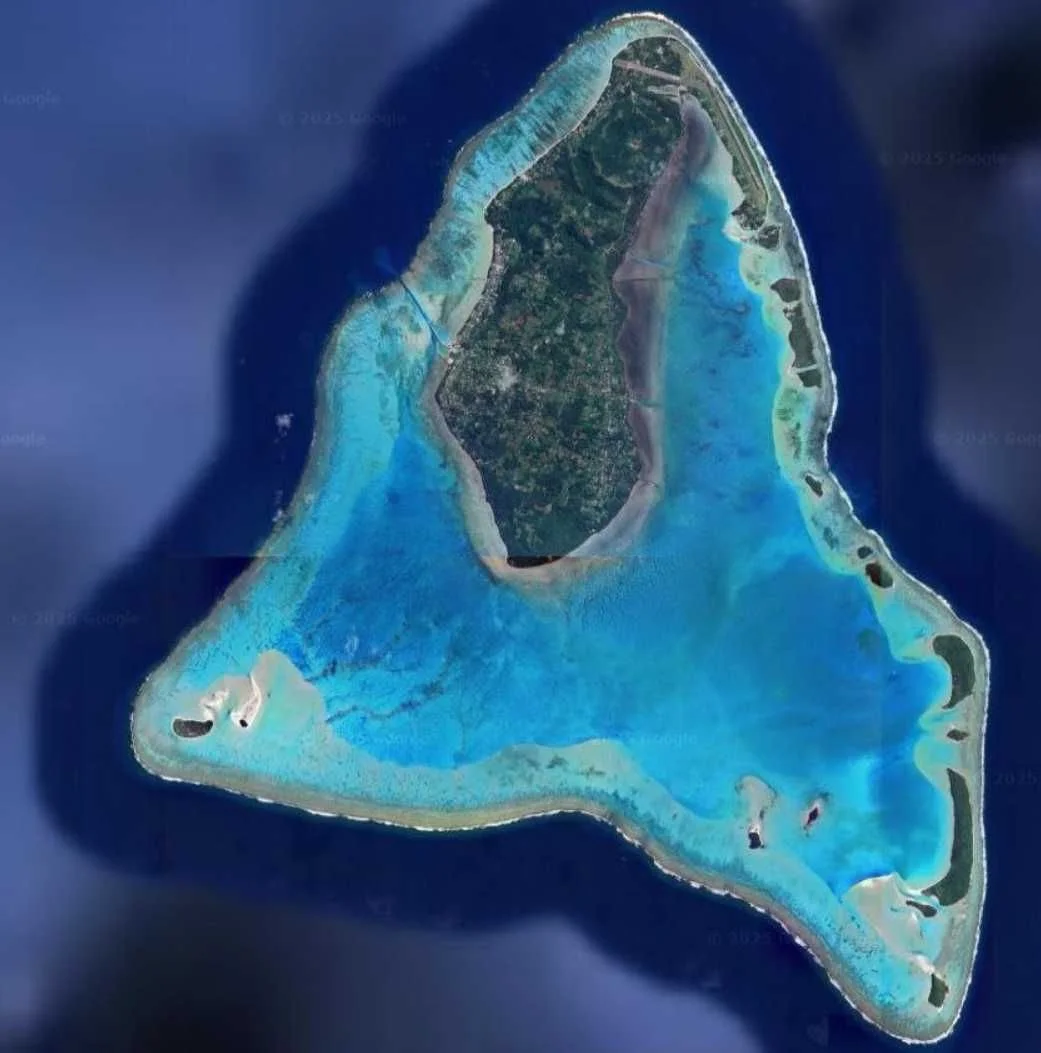
Arutanga, the opal of the Cook Islands.
PRESENT CHAPTER 3 | 15 July 2026
By now the Atlantic feels very far away. The Caribbean, the American coast, British Columbia, Mexico, Central America and Nova Scotia - all of it folded into memory and wake lines.
We are in the Cook Islands, anchored off Arutanga.
There is something quietly significant about this.
Wolfhound is registered in the Cook Islands. Arutanga is the name printed formally on her stern, beneath her sweeping counter - the word that declares her nationality to the world. We have carried that name across oceans, through harbours grand and obscure, into anchorages where no one has heard of it and others where it draws a nod of recognition.
And yet we are only now arriving here for the first time.
I think about the idea of belonging at sea. A vessel must belong somewhere - on paper at least. A port of registry, a flag, an official identity. It is a practical necessity. But when you spend years moving between continents, the idea of home becomes less fixed.
That is why Arutanga feels different.
We approach the harbour not simply as visitors passing through, but as a boat returning - however symbolically - to her place of registration. The name on her stern is no longer abstract. It is real land, real people, real light falling on the water.
The Pacific alters our rhythm. The scale is greater. The distances are humbling. The colours feel almost exaggerated - water shifting from indigo to impossible turquoise, reefs traced in pale jade beneath the surface. The sky seems taller somehow, as though it has been lifted higher above the earth.
Our days are measured by sunrises and log entries.
Our nights divided into watches.
Meals are simple, practical, shared in the cockpit.
There is a stripping back on long Pacific passages.
Fewer distractions. Fewer external demands. The boat becomes the entire world - her sounds, her motion, the small domestic routines that continue no matter how many miles lie beneath the keel.
And then, land.
Low at first. A smudge on the horizon. The particular green of a Pacific island is unmistakable - soft and feathery, rising abruptly from blue water. The scent reaches us before we are properly anchored: vegetation, flowers, warmth.
Inside the reef the lagoon lies calm, the coral wall holding back the long Pacific swell. We ease Wolfhound onto her anchor and, for the first time, look ashore at the name she has carried for so long.
The feeling is less dramatic than one might expect. No trumpets. No revelation. More a quiet alignment - as though a circle, drawn years ago when we first chose her registry, has gently closed.
Cruising teaches us that identity is layered. We are British by birth, Atlantic sailors by experience and Pacific wanderers by choice.
And Wolfhound herself carries all of that in her timbers - yet officially, formally, she belongs to the Cook Islands.
There is something rather wonderful about that. A small act of faith taken years ago now becomes tangible.
July in the Pacific is not about events or regattas. It is about light on the lagoon, about walking ashore in a place that is both foreign and, in an administrative sense at least, ours.
Perhaps we step into the registry office. Perhaps we simply sit in the cockpit at dusk and look toward the lights of Arutanga, aware that for once the name on the stern and the land beyond the anchorage match.
Life at sea so often feels like a string of departures. July feels like an arrival - not permanent, not possessive, but meaningful.
Over the years we learn that home is not a fixed point on a chart.
It is the boat. The partnership. The willingness to keep going.
But sometimes it is also a name, painted carefully on a stern, finally seen in its own harbour.
And that feels quietly important.
Until the next horizon,
Lou x