
North to the city, and beyond
MEMORY CHAPTER 3 | 15 JUNE 2026
It was time to go north.
Our next adventure was to be New York City. The plan was ambitious and thrilling in equal measure: take Wolfhound up the East River, through the heart of the city, and out into Long Island Sound. To sail your own boat past Manhattan is the sort of experience that lodges in the imagination long before it becomes reality.
We left Cape May and sailed overnight along the New Jersey shoreline. The lights of Ocean City and Atlantic City glowed against the dark, casting a golden haze over the sea. Offshore at night, the coastline becomes a constellation - a reminder that life continues brightly ashore while you move quietly past.
By dawn we were abeam Sandy Hook, which marks the southern shore of the entrance to the Hudson River and the waters of New York Harbor. The skyline lay somewhere ahead of us, just beyond the curve of the earth.
We were aware of the regulation: you are not permitted to transit New York Harbor under sail alone. The engine must be running.
Steven turned the key. The engine turned over - but did not start.
He tried again. Nothing.
In an instant, anticipation gave way to calculation. We were drifting at about two knots in virtually no wind, surrounded by fishing boats and edging toward a lee shore. The skyline would have to wait. There is no romance in mechanical failure at the wrong moment.
We tacked slowly away from the coast and made the decision to head east along the southern shore of Long Island. The East River would not be ours that day.
As we drifted in the light air, I spent hours trying to reach a John Deere engineer who might help us at short notice. No luck. Every mechanic was flat out servicing the commercial fishing fleets. A yacht was, understandably, not a priority.
So we sailed.
The journey to the eastern end of Long Island took two days in reluctant wind. It was not dramatic, just slow and deliberate. We finally sailed into Greenport and dropped anchor outside the harbor, hoping for better fortune.
Eventually it came - not locally, but in Fairhaven, Massachusetts. An engineering works there agreed to help us. All we had to do was sail there.
Between us and Fairhaven lay Block Island Sound and Buzzards Bay, with their notorious tidal switches and currents. Under normal circumstances we might have chosen our weather window more carefully. But this time we had no engine, and no choice.
The exercise was challenging - and deeply satisfying. Sailing Wolfhound without mechanical assistance reminded us what she was designed to do. We worked tides carefully, timed our departures, read the water. When you cannot rely on the engine, you sharpen your other skills. Nearly three weeks after we had tacked away from Sandy Hook, we arrived off the hurricane barrier at the entrance to New Bedford and Fairhaven Harbor.
The gate in the barrier is 150 feet wide. Under power, straightforward. Under sail, with the wind dead on the nose, impossible.
We called Bob Mitchell of R.A. Mitchell’s to announce both our arrival and our predicament.
“No problem,” he said. “My brother Charlie has a tug. We’ll be with you within the hour.”
Steven often says it is not the places we have been but the people we have met that have made these years extraordinary. Bob and Charlie proved the point immediately.
Charlie Mitchell and his tug Jaguar are well known along the Eastern Seaboard. Over a long career he has conducted heroic salvage operations and delicate tows that others would not attempt. He and Jaguar are considered the only team skilled enough to tow Mayflower II wherever and whenever required, along with other notable historic vessels. At one point he even towed a dead sperm whale from Nantucket to New Bedford for the whaling museum.
We were, unquestionably, in safe hands.
Charlie arrived with calm assurance. Bob came along as line handler, and within minutes Wolfhound was under professional escort through the barrier and into the harbor. By the end of the day we had not only solved our immediate problem, but met two men we are proud to call friends.
Charlie offered Steven the use of a room in his house as a temporary studio. From the window he could look out across Fairhaven Harbor and keep an eye on Wolfhound, anchored at the end of Charlie’s garden. It was one of those improbable arrangements that cruising life produces - generous, practical, and entirely human.
While Steven painted, Bob’s engineers worked methodically on the engine. I explored Fairhaven’s delightful architecture, cycled the coastal path toward the Cape Cod Canal, and joined Charlie and Bob for lunches of scallops and fresh fish in the local café. Days that might have been stressful became unexpectedly rich.
Fairhaven holds a quiet place in sailing history. It was here that Joshua Slocum rebuilt his vessel Spray before setting off on his solo circumnavigation, later chronicled in Sailing Alone Around the World. There is a modest plaque at Poverty Point marking where Spray was prepared. We had not made the connection before arriving. It felt like a quiet benediction.
Time, however, was moving on. We wanted to reach Nova Scotia for the Nova Scotia Schooner Regatta. We said goodbye to Bob and Charlie and headed for the Cape Cod Canal.
With a five-knot current in our favor we shot through the canal and popped out into Cape Cod Bay - directly in front of a finback whale. We dropped anchor off Provincetown for the night, humbled and exhilarated.
The waters around northern Cape Cod were alive with whales. We saw pods of pilot whales and had a North Atlantic right whale breach less than thirty feet from the boat - an unforgettable and sobering sight, given how few remain.
From there we set course for Nova Scotia. It was a glorious 240-mile sail with the wind on the beam. We passed Cape Sable at dawn and made landfall in Canada in the charming town of Shelburne.
The welcome from the Shelburne Harbour Yacht Club and the Nova Scotian Schooner Society was extraordinary. With the exception of us and two schooners from the United States, the fleet was local. These vessels are built for North Atlantic weather - capable, tough, purposeful. Their captains and crews are much the same: rugged, generous, quietly proud.
After the regatta we were encouraged to sail east toward Lunenburg, home port to many of the schooners. The name caught Steven’s attention immediately.
It was in Lunenburg that the replicas of HMS Rose and HMS Bounty were built, along with the replica of the Grand Banks fishing schooner Bluenose II. These ships hold particular meaning for Steven. The original HMS Rose and HMS Bounty were built in Hull, Yorkshire - his hometown. The 1960 Bounty replica was constructed for the Marlon Brando film Mutiny on the Bounty, the movie that ignited Steven’s childhood dream of sailing to Tahiti.
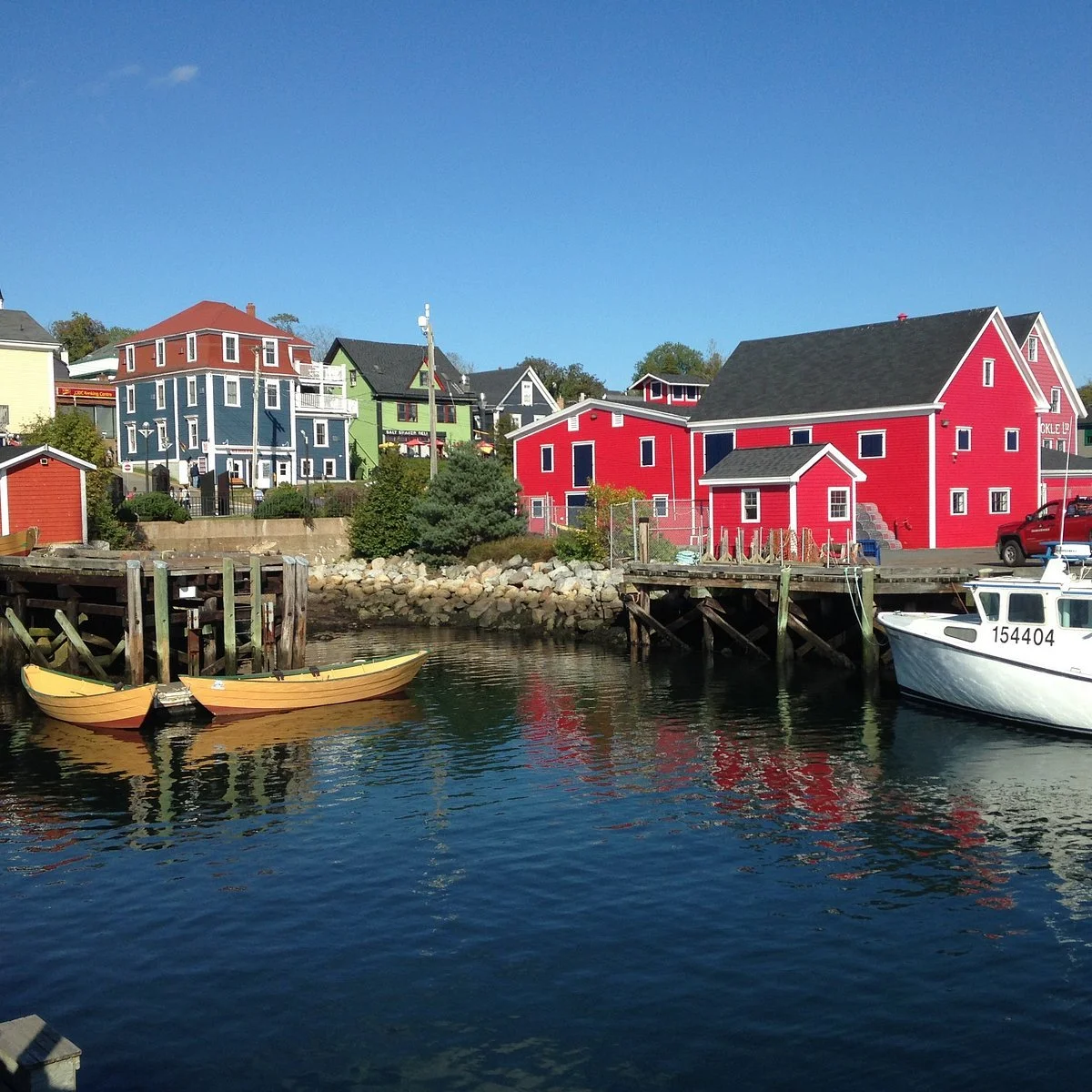
The big boat shed in Lunenburg, built in the 1930s entirely of timber, is an architectural marvel. Schooners are still built there, and we were privileged to witness the launch of one during our stay - a spectacle of craftsmanship and continuity. Lunenburg itself is a working waterfront. Fishing boats unload scallops from the Grand Banks. Dories and schooners are built and repaired. Rising above the wharves are brightly painted historic houses. The entire old town is a UNESCO World Heritage Site, and deservedly so.
We fell in love with it immediately.
We decided to stay for the summer.
As had become our routine, Steven began asking around for studio space. He was offered the use of the boardroom in one of the historic waterfront buildings belonging to Adams & Knickle, a fishing company operating continuously since 1897. Jane Adams Ritcey, a descendant of the founders and an art enthusiast, welcomed a marine artist without hesitation.
The building could not have been more appropriate. Nets and equipment were stored below; the scent of cordage, tar, and fish lingered in the air. Outside, wooden shingles were split and painted by hand as part of ongoing restoration. The loft had temporarily become a paint shop.
Tall ships such as Europa and Picton Castle berthed regularly at the wharf outside Steven’s studio window. Immersed in the sounds and textures of maritime life, he began work on a painting of San Francisco Harbor in 1890 - inspiration readily available just beyond the glass.
We made lasting friendships in Lunenburg. It was an easy place to blend into, to become known.
Before winter, we sailed back to Massachusetts to visit Bob and Charlie once more. Anchored off Charlie’s house, Steven received a message from Russ Kramer inviting us to attend a conference of the American Society of Marine Artists at the Mystic Seaport Museum two days hence.
We weighed anchor immediately.
The passage to Connecticut proved punishing. Buzzards Bay lived up to its reputation, throwing up short, steep seas as we punched into wind and tide under power for hours on end. It was a stark reminder that if you do not work with wind and tide, you will pay for it.
We paid.
But as ever, hardship gave way to arrival - and arrival to people.
And once again, it was not the miles that mattered most, but those we met along the way.