
Westward from California
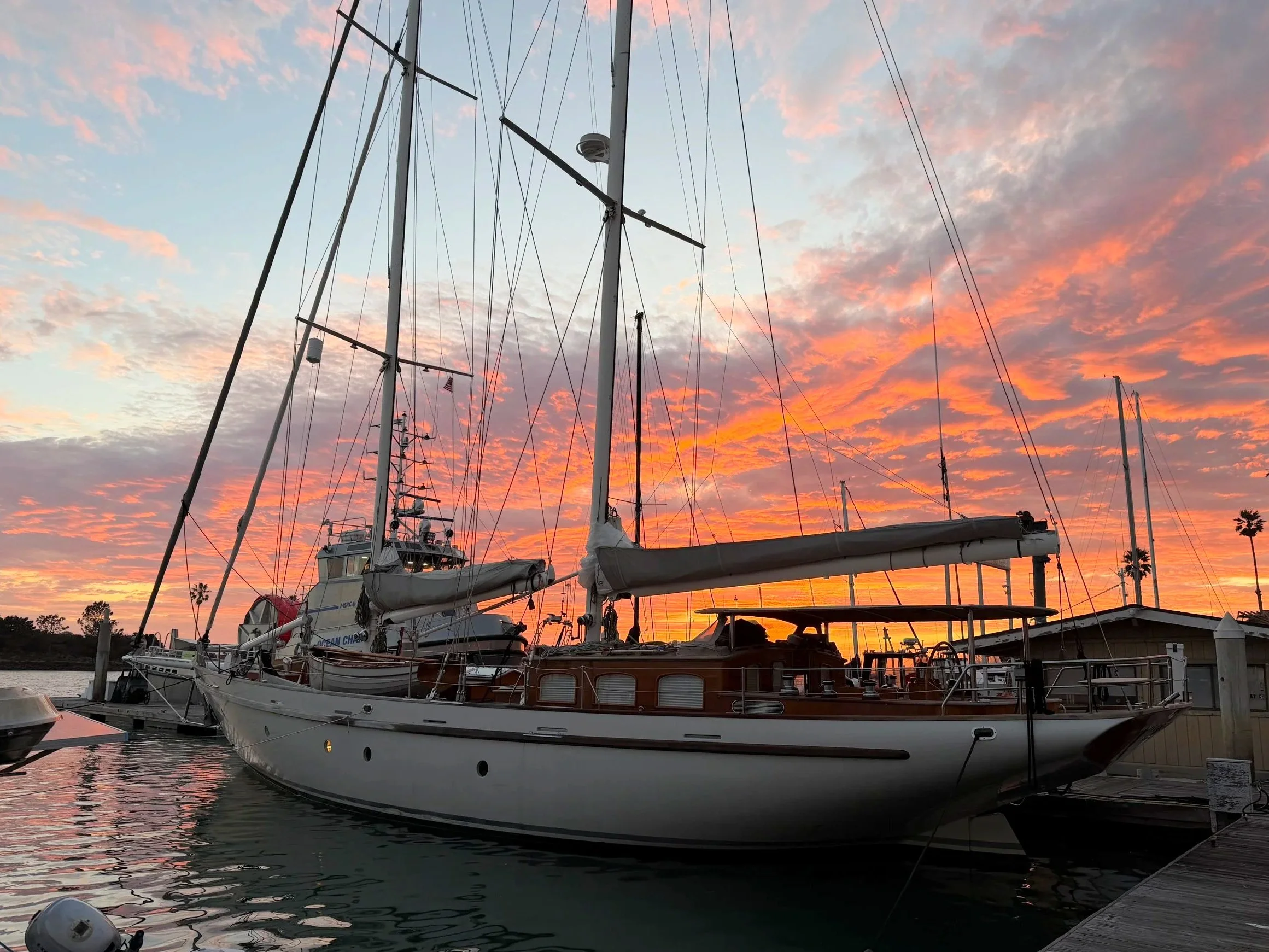
Westward ho!
PRESENT CHAPTER 1 | 15 MARCH 2026
As I stand on deck polishing the stainless steel winches, my eyes wander across the activity in this busy harbour before drifting west toward the open Pacific. Sailboats glide quietly between moorings, tenders buzz back and forth carrying provisions and crew, and seabirds circle lazily overhead, hoping for an easy meal. It is the familiar choreography of a working marina - purposeful, slightly chaotic, and comforting in its rhythm.
Beyond the bustle, the horizon stretches wide beneath the pale California sky. The only thing between us and that vast sweep of ocean is Catalina Island, resting quietly off the southern coast. From here it looks almost deceptively close - a soft outline rising from the sea. Yet beyond it lies thousands of miles of uninterrupted water, a crossing that will take us further from land than we have ever been before.
Here in this harbour we are preparing Wolfhound for the longest passage we have undertaken in our ten years of cruising.
If all goes according to plan, we will depart on Saturday the 14th of March, setting our course southwest toward the Marquesas Islands of French Polynesia. It is a journey of roughly 4,200 nautical miles - about 4,800 land miles - and at an average speed of around 6.5 knots it will likely take us close to four weeks to complete. When measured that way, mile by mile and hour by hour, it is a long way indeed.
Steven has been carefully watching the weather forecasts, studying the shifting patterns that will guide our route across the Pacific. Ocean passages are rarely straight lines. Instead, they are thoughtful negotiations with wind, current, and weather systems that evolve day by day. The plan changes slightly as new forecasts arrive, but at the moment it appears we may have a reasonably steady passage. No speed records will be broken by this yacht, but with a little luck and cooperative winds we may make landfall in just under four weeks.
Preparation for a crossing of this distance is intense and detailed. Every system on the boat must be checked, serviced, and trusted to work reliably for weeks without assistance. The engine, rigging, electrical systems, watermaker, navigation instruments - everything must be inspected and maintained. Out here there are no repair yards or spare parts stores just around the corner.
Our safety equipment has been carefully examined as well. The life raft, flares, harnesses, emergency beacons, and radios have all been tested. The first aid kit has been fully restocked with everything from seasickness remedies to sutures and antibiotics. Our grab bags - the emergency evacuation bags that would come with us if we ever had to abandon the boat - have been updated and repacked. These are tasks you hope will never prove necessary, but preparing them properly provides quiet reassurance.
Meanwhile an engineer has been aboard servicing the generator, making sure it will run smoothly for the many hours it will need to provide power during the passage. A diver has been down beneath the boat, scrubbing away the thin layer of marine growth that inevitably collects on the hull and greasing the propeller. A clean hull makes a surprising difference to a boat’s efficiency over thousands of miles.
Provisioning has perhaps been the most visible part of the preparations. Over the past week I have lugged countless bags and boxes of supplies down the dock and into the galley. It always looks slightly excessive when piled on the cockpit seats - mountains of fruit, vegetables, dry goods, tins, grains, and treats - but when you calculate meals for four weeks or more at sea it quickly becomes clear how necessary it is.
I have also spent long hours cooking large batches of meals to fill the freezer. Chilli, spaghetti bolognese, and hearty casseroles now wait neatly labelled and stacked. On calm evenings at sea cooking can be a pleasure, but when the boat is rolling and pitching it is a different story entirely. Having nourishing meals ready to warm up will make life far more comfortable when the conditions are less forgiving.
Even with all that completed, there is still a good deal of work to finish before Saturday arrives. Boats have a way of producing endless small tasks, and as one item is crossed off the list another seems to appear. Yet as we edge closer to departure the feeling aboard shifts subtly from preparation to anticipation.
The excitement is building.
There is something deeply compelling about the moment just before a long passage begins. The boat is ready, the course is set, and ahead lies an expanse of ocean that will carry us into entirely new places. After so many weeks of preparation we are both eager to slip the lines, leave the harbour behind, and settle once again into the quiet rhythm of life at sea.
The first few days offshore are always the most tiring. It takes time for both body and mind to adjust to the movement of the boat and the patterns of watchkeeping. Our routine will be simple but demanding: three hours on watch followed by three hours off, day and night, for the duration of the passage.
Those early days can feel slightly disorienting as sleep comes in short fragments and the constant motion requires careful balance with every step. But usually, within three days or so, something changes. The tempo of life on land - the emails, schedules, traffic, and endless noise - slowly dissolves.
The ocean imposes its own pace.
Thoughts become quieter. Time stretches. Days are marked by sunrise, sunset, and the steady progress across the chart. It is a rhythm that encourages reflection and long, uninterrupted stretches of thought.
For me, those quiet hours often become a time for creativity. I plan to use some of the passage to develop design ideas that have been lingering in my mind for months. Life on land can be wonderfully full but also crowded with obligations, leaving little space for imagination to wander. At sea that space returns.
Sometimes the best ideas arrive during a quiet night watch, when the boat glides forward beneath a sky filled with stars.
Of course, leaving is never entirely easy. Over the years we have been fortunate to build friendships in many places, and here in California we are surrounded by wonderful friends and family. One of the realities of a life like this is that we are often moving on just as connections deepen.
There are moments when that can feel difficult.
But we have also learned that distance does not diminish true friendship. The people we meet along the way become part of our lives in lasting ways, even when oceans lie between us. Messages, calls, and occasional reunions in unexpected harbours keep those connections alive.
So as we prepare to sail west, we carry those friendships with us.
Soon Catalina will slip astern, the California coast will fade into the distance, and the Pacific will open around us. Four thousand miles of ocean lie ahead, along with weeks of wind, stars, quiet watches, and the steady movement of Wolfhound beneath our feet.
We cannot wait to begin.
Until the next horizon,
Lou x