
Why we went
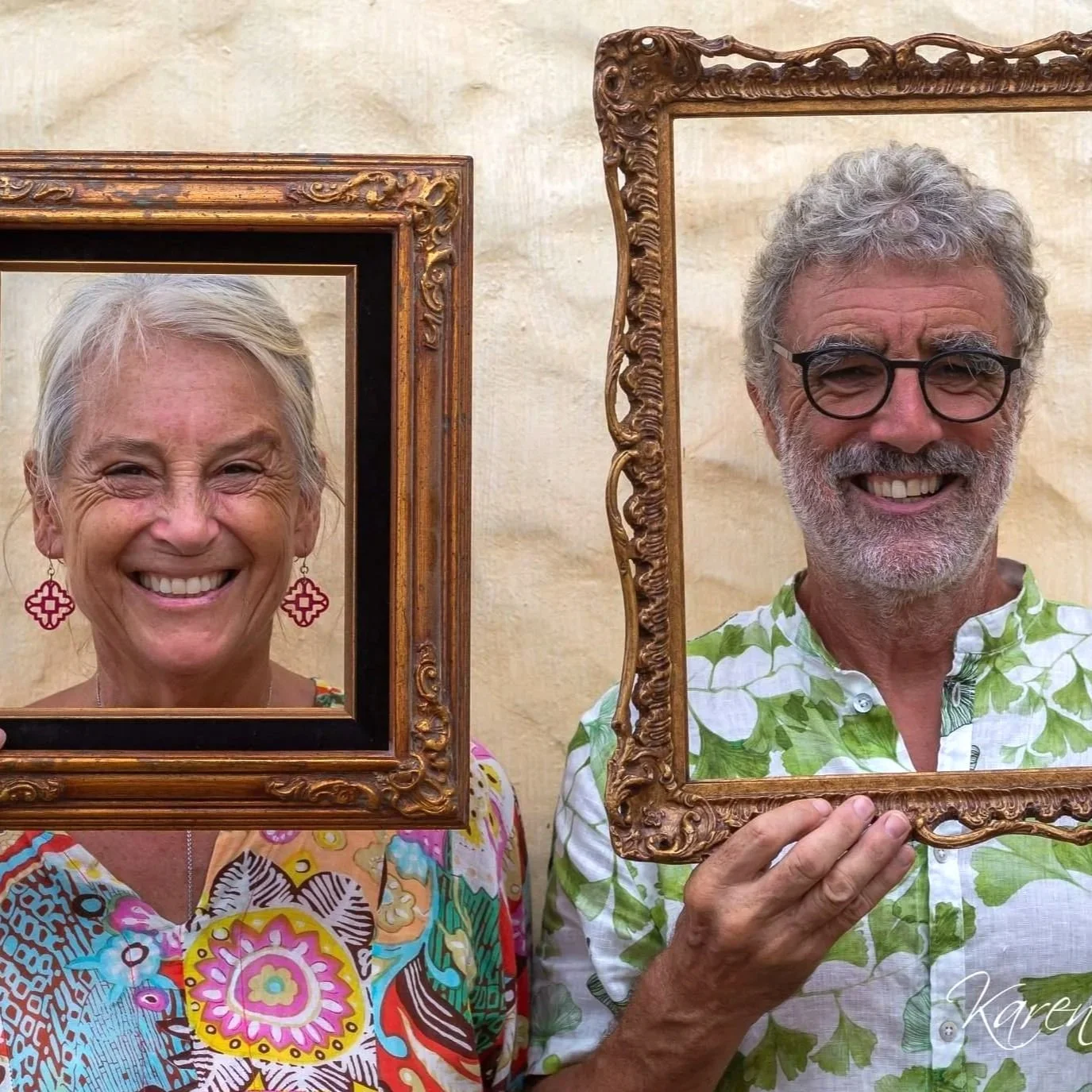
Portrait of my husband, Steven and I in Havana, Cuba (© Karen Key)
MEMORY CHAPTER 1 | 15 FEBRUARY 2026
For a long time we have been asked how this life began.
Not the sailing - that runs deeper - but the decision. The point at which intention became action. The moment when a horizon stopped being theoretical and started asking something of us.
This year, I am going to tell the story properly.
Not as instruction. Not as spectacle. But as it happened - in chapters. Some from where we are now. Some from the years that led us here. Boats, certainly. But also people. Places. Work. Risk. Partnership. The slow shaping of a shared dream. It did not begin with a grand departure.
It began, as many life-altering things do, almost accidentally.
The boat we didn’t mean to buy
We drove down to Sydney for a matinee at the Ensemble Theatre in Careening Cove. It was meant to be nothing more than a day out - a small civilised interlude in the middle of farm life. We parked on the far side of the cove and walked around the water to the theatre, enjoying the quiet rhythm of masts and moorings as we went.
After the performance we retraced our steps, crossing the slipway of a small boatyard. And there, up on the ways, was a perfectly restored six-metre Fife.
We have always been magnetically drawn to classic yachts. There is something about line and proportion in those old boats that speaks directly to us. And Fife yachts sit at the very pinnacle of that affection. My first crewing job in my early twenties had been aboard Sumarun, the 1914 Fife built for the Teacher’s Whisky family.
So we stopped. Of course we did.
As we stood admiring her, the owner of the yard wandered over for a chat. He asked, casually enough, whether we were looking to buy a yacht.
We laughed.
Not at all, we told him. That part of our lives was behind us. We had moved on. There was a farm to run, children to raise, responsibilities that did not allow for indulgence. Yachting, we said, belonged to another chapter.
He didn’t seem to believe us.
Before we quite understood what was happening, we were aboard his launch, motoring out of Careening Cove toward Shell Cove while he explained that a yacht was about to come into his yard for cosmetic work before being offered for sale.
He throttled back and pointed toward a slip at the end of a garden.
I loved her immediately.
She was tired - canvas in tatters, varnish peeling - but she had presence. A cutter rigged sloop, flush deck, bronze fittings throughout. Built in Newport Beach, California, by a craftsman, shipped to Australia as deck cargo in the 1980s. Even from a distance she had pedigree.
We couldn’t see below decks - there was no key - but the yard owner assured us she was built like a Steinway piano.
We stood quietly, taking her in.
And then we did the sensible thing. We said no.
We returned to the yard, left our contact details at his request, and drove home assuming the matter closed.
Halfway through that evening the phone rang. We answered, and as the conversation unfolded we felt the air in the room change. The owner had a proposition.
We looked at each other.
It took perhaps ten seconds.
Suddenly we had a yacht.
Having a yacht back in our lives revealed something we had not admitted: we had missed the sea. We kept her in Port Stephens, an hour from our farm, and sailed whenever we could steal the time. Over eight years we taught the younger children to sail. We cruised, raced locally, pottered, restored, maintained.
She quietly recalibrated us.
She reminded us what horizon does to the spirit.
In time we understood that if we wanted to cross oceans in comfort, we would need something larger, with greater range and stronger systems. So in 2007 we made the decision to sell the farm and go sailing.
We imagined it would happen quickly.
It would take another nine years.
The idea of crossing the Pacific had lived with us for a long time. If we were going to do this properly, it would be in a schooner.
Not simply because of romance, though there is beauty in that rig, but because a schooner is practical for short-handed sailing. Balanced. Manageable. Forgiving.
We searched the second-hand market with a very specific list and quickly realised compromise would be inevitable. We didn’t want compromise.
So we commissioned her.
A Dutch naval architect drew the lines - hull and rig only. The interior we designed ourselves. We cleared the farm machinery from the barn, swept the concrete floor, and drew the layout full scale in chalk. We lived inside that chalk outline for days. We swung imaginary doors. Measured headroom. Positioned light switches. We even brought in an old marine toilet to check knee room with the door closed. It was meticulous and faintly ridiculous - and absolutely necessary.
We both love the creative process - the excitement of bringing something from imagination into reality.
When we were satisfied, the drawings were sent off to be formalised.
We had already chosen her name.
When we first moved to the farm in the Hunter Valley we rescued two wolfhound brothers. We needed good guard dogs that were safe with children, and these enormous creatures with marshmallow hearts were perfect. They were loyal, calm, gentle, imposing without aggression. They lived long, good lives with us.
When it came time to name the schooner, Wolfhound was obvious. Grace. Speed. Loyalty. Presence.
We chose a small yard in Dorset, England, to build her - a husband-and-wife operation with two shipwrights. It felt right from the beginning. We did not yet know that we would be tied together for eight years.
The contract was signed in early 2008, optimistically imagining completion in eighteen months.
Then the financial world collapsed.
The build slowed to a crawl. We supported family and farm in Australia while trying to keep the project alive in England. There were years of strain. Real strain. Responsibility not only to ourselves but to the yard and the men whose livelihoods depended on the continuation of the work.
There were moments it felt impossible. But the build never stopped entirely.
Every Sunday evening photographs would arrive by email - the week’s progress. We printed them, Steven painted over them to indicate finishes, sketched 3D interiors, refined details remotely. Once a year one of us flew to the UK to stand in the shed and touch the timber.
Eventually we sold the farm. The dogs were gone by then. The horses rehomed. Cattle sold. Our belongings packed into a forty-foot container.
We moved between France, Australia, and New Zealand while the final stages crept toward completion. Studios were set up in spare bedrooms overlooking the Channel, above chicken barns in Normandy, beside the Lot River, then in a borrowed beach house north of Sydney. Steven painted. Systems were specified. Equipment sourced.
And at last, in June 2016, she was ready to leave the shed.
Getting her to the water required cranes, escort vehicles, route surveys, and the negotiation of a narrow 1795 bridge whose trees had grown considerably in eight years. She travelled to Southampton on the back of a low loader like some improbable migrating creature.
When she finally hung in the slings and touched the water, there was no drama. Just deep, steady satisfaction.
A lifetime of intent made tangible.
There were sails to bend on, masts to be rigged, systems to test. We sailed down the Solent in a stiff August breeze and left the Needles astern.
She was beautifully balanced. In the Bay of Biscay she asked her first question of us.
A sudden roll, a hand in the wrong place, a sheet block taking the pad of a finger clean to bone. It was over in a second. Blood, bandage, sling. Three days still to La Coruña. The sea does not care about dreams. It simply requires competence.
We carried on.